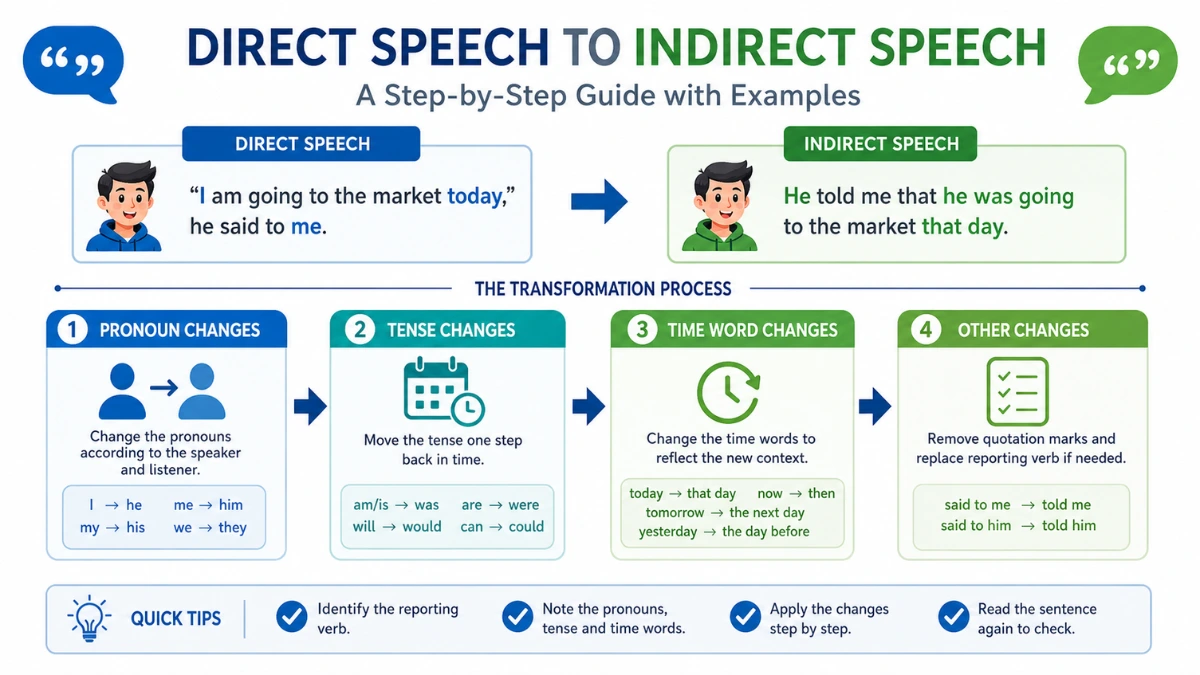
Narration is one of the most important topics in English grammar, especially for students in Pakistan. Many students feel confused when they see direct and indirect speech questions in exams. But the truth is, once you understand the logic behind it, narration becomes very easy and even interesting.
When we talk about how to change narration, we are simply learning how to report someone’s words in a different way. This skill is useful not only for exams but also for writing essays, stories, and even daily conversations.
In this detailed guide, you will learn narration step by step in very simple English. We will not only explain rules but also clear your confusion, show real-life examples, and teach you how to use narration naturally.
What is Narration? (Clear Understanding First)
Narration means telling or reporting what someone has said. There are two ways to do this:
- Direct Speech: Exact words of the speaker
- Indirect Speech: Reporting the meaning of those words
Example:
| Type | Sentence |
| Direct | Ahmed said, “I am playing.” |
| Indirect | Ahmed said that he was playing. |
- The main idea is simple: Direct speech shows original words, while indirect speech explains them.
Why Students Must Learn Narration
Many students only study narration to pass exams, but its importance is much bigger.
Narration helps you:
- Write better answers in exams
- Improve your English writing style
- Avoid repeating quotation marks again and again
- Speak English more naturally
In board exams, narration questions are often easy marks if you understand the rules properly. That is why learning how to change narration correctly can improve your overall English performance.
Core Concept: What Actually Changes in Narration?
Before jumping into rules, you must understand what really changes when we convert a sentence.
There are four main changes:
| Element | What Happens |
| Pronouns | Change according to subject |
| Tense | Often changes to past |
| Time Words | Change based on situation |
| Sentence Structure | Changes based on sentence type |
If you understand these four points clearly, narration becomes much easier.
Step-by-Step Method to Change Narration (Most Important Section)
This is the heart of narration. Follow these steps carefully like a teacher guiding you.
Step 1: Identify the Reporting Verb
The reporting verb is usually “said” or “told”.
Example:
- Ali said, “I am tired.”
- Here, “said” is the reporting verb.
- If it is in present tense (says), then rules will change slightly.
Step 2: Remove Quotation Marks
Indirect speech does not use quotation marks.
- Direct: She said, “I am ready.”
- Indirect: She said that she was ready.
Step 3: Add Linking Word
In most cases, we use “that” to join sentences.
- Direct: He said, “I like cricket.”
- Indirect: He said that he liked cricket.
Note: In spoken English, “that” is sometimes skipped, but in exams, it is better to use it.
Step 4: Change Pronouns Carefully
This is where many students make mistakes.
Rule: Pronouns change according to the subject and object.
| Direct Pronoun | Indirect Pronoun |
| I | He / She |
| We | They |
| My | His / Her |
| Our | Their |
Example:
- Direct: Sara said, “I love my school.”
- Indirect: Sara said that she loved her school.
Step 5: Change the Tense (Very Important)
If the reporting verb is in past tense, the tense usually changes.
| Direct Speech | Indirect Speech |
| Present Simple | Past Simple |
| Present Continuous | Past Continuous |
| Present Perfect | Past Perfect |
| Past Simple | Past Perfect |
Example:
- Direct: He said, “I am studying.”
- Indirect: He said that he was studying.
Important Note: If the reporting verb is in present (says), tense does not change.
Step 6: Change Time and Place Words
Time words also change to match the new situation.
| Direct | Indirect |
| Now | Then |
| Today | That day |
| Tomorrow | The next day |
| Yesterday | The previous day |
| Here | There |
Example:
- Direct: She said, “I will come tomorrow.”
- Indirect: She said that she would come the next day.
Understanding Different Sentence Types in Narration
Narration is not only about rules. You must also understand sentence types.
Assertive Sentences (Statements)
These are simple sentences.
Structure: Subject + said + that + clause
Example:
- Direct: He said, “I am happy.”
- Indirect: He said that he was happy.
Interrogative Sentences (Questions)
These need special attention.
Yes/No Questions
Use “if” or “whether”
| Direct | Indirect |
| He said, “Are you ready?” | He asked if I was ready. |
WH Questions
Use the same question word.
| Direct | Indirect |
| She said, “Where are you going?” | She asked where I was going. |
Important Rule: Do not use “that” in questions.
Imperative Sentences (Orders, Requests, Advice)
We use different verbs based on meaning.
| Direct | Indirect |
| He said, “Open the door.” | He told me to open the door. |
| She said, “Please help me.” | She requested me to help her. |
| Teacher said, “Work hard.” | Teacher advised us to work hard. |
Exclamatory Sentences (Emotion)
These show feelings like happiness, surprise, or sadness.
| Direct | Indirect |
| He said, “What a beautiful day!” | He exclaimed that it was a very beautiful day. |
Real-Life Usage of Narration (Very Important for Understanding)
Students often learn rules but don’t know where to use them.
In Classroom
- Teacher says: “Complete your homework.”
- Student writes: The teacher told us to complete our homework.
In Exams
Narration questions are common in English papers.
Example:
- He said, “I am preparing for exams.”
- Answer: He said that he was preparing for exams.
In Story Writing
Instead of writing many quotes, we use indirect speech.
Example:
- He said that he was going to the market and would return soon.
In Daily Conversation
- Friend: “I will call you tonight.”
- You say: He said that he would call me that night.
Common Confusions Students Face
Understanding these will improve your accuracy.
Confusion 1: Tense Always Changes
Wrong idea. Tense does not change if reporting verb is in present.
Example:
- He says, “I am happy.”
- He says that he is happy.
Confusion 2: Wrong Pronoun Use
- Students forget who is speaking.
- Always ask: Who is “I”?
Confusion 3: Using “that” in Questions
- Incorrect: He asked that where I was going.
- Correct: He asked where I was going.
Common Mistakes Table
| Wrong Sentence | Correct Sentence | Explanation |
| He said that I am tired. | He said that he was tired. | Pronoun + tense error |
| She said she is happy. | She said that she was happy. | Missing tense change |
| He asked that where I was going. | He asked where I was going. | Wrong structure |
| She said I will come. | She said that she would come. | Pronoun mistake |
| He said “he is ready”. | He said that he was ready. | Quotation + tense error |
Practical Application (Real Student Usage)
Narration is not just a grammar rule. It is a practical skill.
In Exam Writing
Students who understand narration can easily solve grammar questions and score high marks.
In Essays and Stories
Indirect speech makes writing smoother and more professional.
Example paragraph:
- The teacher told the students to focus on their studies and advised them to work hard for exams. The students said that they would follow her advice.
In Spoken English
When you tell someone what another person said, you use narration.
Example:
- My brother told me to bring water.
In Notes and Summaries
Students use narration to write short summaries of lectures.
Practical Tips to Master Narration
- Always identify sentence type first
- Focus deeply on pronouns
- Learn tense changes properly
- Practice daily with real sentences
- Read examples again and again
- Write your own sentences for better understanding
Summary
| Key Point | Explanation |
| Narration | Reporting speech |
| Types | Direct and Indirect |
| Main Changes | Pronoun, tense, time words |
| Important Skill | Practice and understanding |
| Exam Benefit | Easy scoring topic |
Read More: Our Part of Speech in English: Complete and Detailed Guide with Easy Examples
Conclusion
Learning how to change narration becomes easy when you understand the logic behind it instead of memorizing rules blindly. Focus on pronouns, tense, and sentence types, and practice regularly.
If you give time to practice and understand real examples, narration will no longer feel difficult. Instead, it will become one of the easiest and most scoring topics in English grammar.
Frequently Asked Questions
What is the easiest way to learn narration?
Start with simple sentences and follow step-by-step rules.
Is narration important for exams in Pakistan?
Yes, it is very important and often comes in papers.
Does tense always change in narration?
No, it depends on the reporting verb.
How can I avoid mistakes in narration?
Focus on pronouns and sentence type carefully.
Can I skip “that” in indirect speech?
Yes, but in exams it is better to use it.