Many students feel confused when they study English tenses. They see many rules, forms, and structures, and sometimes it feels difficult to remember everything. But the truth is, learning tenses is not as hard as it looks if you follow simple steps and practice regularly.
Understanding how to learn tenses easily is very important for students in Pakistan and other countries where English is learned as a second language. Tenses help us talk about the past, present, and future correctly. They are used in essays, exams, conversations, and daily writing.
In this guide, you will learn easy tricks, simple tables, and practical methods that will help you understand tenses clearly and remember them for a long time.
What Are Tenses and Why Are They Important?
Tenses show the time of an action. They tell us when something happens — in the past, present, or future.
Without tenses, sentences become confusing. Correct tenses help readers and listeners understand your message clearly.
For example:
| Sentence | Meaning |
| I eat breakfast. | Present action |
| I ate breakfast. | Past action |
| I will eat breakfast. | Future action |
Students need tenses for:
- Writing essays
- Speaking English correctly
- Understanding grammar rules
- Passing school exams
Understanding the Three Main Tense Groups
Before learning many rules, students should first understand the three main tense groups.
Present Tenses
Present tenses talk about actions happening now or regularly.
| Tense Name | Example Sentence | Use |
| Present Simple | I play cricket. | Daily routine |
| Present Continuous | I am playing cricket. | Action happening now |
| Present Perfect | I have played cricket. | Completed action |
| Present Perfect Continuous | I have been playing cricket. | Action continuing |
Past Tenses
Past tenses describe actions that already happened.
| Tense Name | Example Sentence | Use |
| Past Simple | I played cricket. | Completed action in past |
| Past Continuous | I was playing cricket. | Action happening in past |
| Past Perfect | I had played cricket. | Earlier past action |
| Past Perfect Continuous | I had been playing cricket. | Continuous past action |
Future Tenses
Future tenses talk about actions that will happen later.
| Tense Name | Example Sentence | Use |
| Future Simple | I will play cricket. | Future action |
| “Going to” Future | I am going to play. | Planned action |
| Future Continuous | I will be playing. | Ongoing future action |
| Future Perfect | I will have played. | Completed future action |
Understanding these three groups is the first step in learning how to learn tenses easily.
Simple Method to Learn Tenses Step by Step
Many students try to learn all tenses at once. This creates confusion. A step-by-step method works much better.
Step-by-Step Learning Plan
| Step | What to Do | Example |
| Step 1 | Learn Present Simple first | I play football. |
| Step 2 | Learn Present Continuous | I am playing. |
| Step 3 | Move to Past Simple | I played. |
| Step 4 | Learn Future Simple | I will play. |
| Step 5 | Add advanced tenses slowly | I have played. |
This method helps students understand grammar clearly without feeling pressure.
Easy Tricks to Remember Tense Structures
Many students forget tense formulas. Simple memory tricks can help.
Basic Tense Structure Table
| Tense | Helping Verb | Main Verb Form | Example |
| Present Simple | do/does | base form | She plays. |
| Present Continuous | am/is/are | verb + ing | She is playing. |
| Past Simple | did | verb (past form) | She played. |
| Future Simple | will | base form | She will play. |
When students memorize these basic patterns, learning advanced tenses becomes easier.
How Daily Practice Helps You Learn Tenses Faster
Learning grammar is like learning sports — practice makes improvement.
Students should practice small exercises every day instead of studying once a week.
Daily Practice Ideas
- Write 5 sentences using one tense
- Read short English paragraphs
- Speak simple sentences aloud
- Change sentences into past or future
For example:
| Original Sentence | Past Form | Future Form |
| I eat rice. | I ate rice. | I will eat rice. |
This kind of practice makes learning how to learn tenses easily more natural.
Using Timelines to Understand Tenses
Timelines help students visualize time clearly.
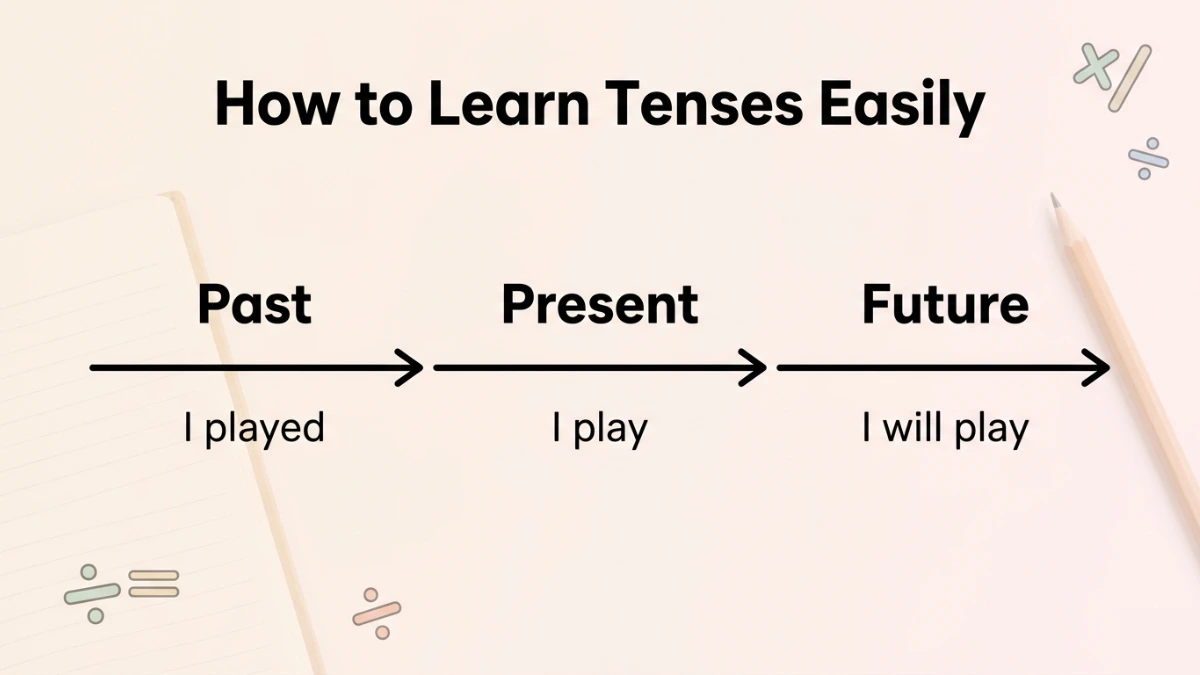
Imagine time like a straight line:
Past → Present → Future
When students connect actions with time, they remember tenses more easily.
For example:
| Time | Sentence |
| Yesterday | I visited my friend. |
| Today | I am visiting my friend. |
| Tomorrow | I will visit my friend. |
Timelines are especially helpful for visual learners.
Common Mistakes Students Make While Learning Tenses
Many students repeat similar mistakes when writing sentences. Understanding these errors helps improve grammar quickly.
| Wrong Sentence | Correct Sentence | Explanation |
| She go to school daily. | She goes to school daily. | Add s with he/she/it. |
| I am go to market. | I am going to market. | Use verb + ing. |
| He did not went home. | He did not go home. | Use base verb after did. |
| We was playing football. | We were playing football. | Use were with plural subject. |
| She have finished homework. | She has finished homework. | Use has with singular subject. |
Learning from mistakes is an important part of understanding how to learn tenses easily.
Real-Life Examples of Tenses in Daily Communication
Students use tenses every day, even without noticing.
At School
- I completed my homework.
- The teacher is explaining the lesson.
- We will take the test tomorrow.
At Home
- Mother is cooking dinner.
- I watched TV yesterday.
- We will visit relatives next week.
With Friends
- I am playing cricket.
- We played football yesterday.
- We will go to the park tomorrow.
These daily-life examples make grammar feel useful and practical.
Practical Application: Real Student Usage
Learning tenses becomes meaningful when students apply them in real writing.
Using Tenses in School Essays
Students often write essays in exams. Correct tense usage improves marks.
| Writing Task | Correct Tense Example |
| Daily Routine Essay | I wake up at 7 am. |
| Story Writing | Yesterday, I visited my uncle. |
| Future Plans Essay | I will become a doctor. |
| Science Report | Water boils at 100°C. |
Mini Real-Life Writing Situations
Situation 1: Writing Homework
- “I finished my homework before dinner.”
Situation 2: Talking About Plans
- “I will study for my exam tonight.”
Situation 3: Describing an Event
- “We were playing when the rain started.”
- These examples show how learning how to learn tenses easily helps in real student writing.
Smart Study Tips for Mastering Tenses
Students do not need to memorize everything in one day. Smart study habits make learning faster and easier.
Helpful Study Tips
- Learn one tense at a time
- Make your own example sentences
- Practice daily for 10–15 minutes
- Use charts and tables
- Revise old tenses regularly
Short daily practice is more effective than long, irregular study sessions.
Simple Comparison of Present, Past, and Future
Understanding the difference between time forms is very helpful.
| Time | Example Sentence | Meaning |
| Present | I read books. | Action happening now or regularly |
| Past | I read books yesterday. | Completed action |
| Future | I will read books tomorrow. | Action not yet happened |
This comparison strengthens understanding of tense usage.
Summary of Important Points
| Key Idea | Explanation |
| Learn step by step | Do not study all tenses together |
| Use daily practice | Write and speak regularly |
| Remember structures | Learn helping verbs carefully |
| Learn from mistakes | Correct errors quickly |
| Apply in real writing | Use tenses in essays and homework |
Conclusion
Learning English tenses may feel difficult at first, but with the right method, it becomes simple and enjoyable. By learning step by step, practicing daily, and using real-life examples, students can improve their grammar quickly.
Understanding how to learn tenses easily helps students write better essays, speak confidently, and perform well in exams. Remember, small daily practice leads to big improvement. Stay patient, keep practicing, and you will master tenses successfully.
Frequently Asked Questions (FAQs)
How can I memorize all tenses easily?
Start with basic tenses first and practice daily. Use tables and make short sentences. Do not try to memorize everything in one day.
How many tenses should I learn first?
Begin with Present Simple, Past Simple, and Future Simple. These are the most commonly used tenses.
Why do I forget tense rules quickly?
Students forget rules when they do not practice regularly. Daily writing and speaking help memory stay strong.
Are tenses important for exams in Pakistan?
Yes, tenses are very important in English exams. They are used in essays, grammar questions, and comprehension.
What is the fastest way to improve tense usage?
The fastest way is daily practice, reading English texts, and correcting mistakes.