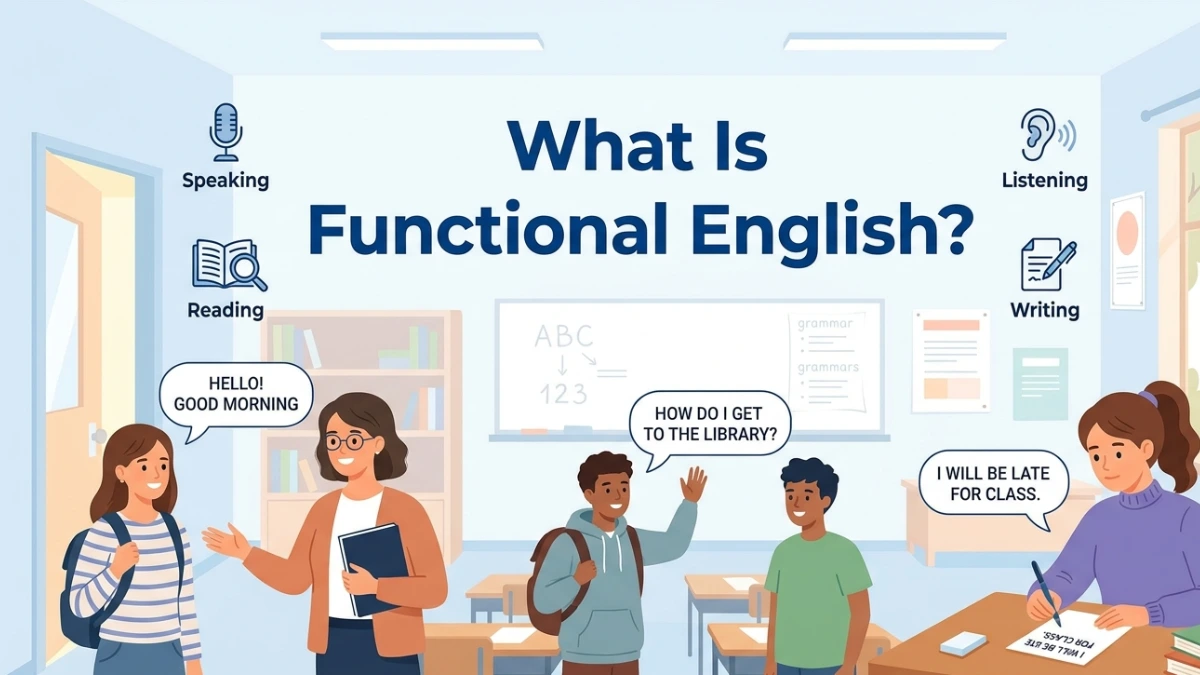
Many students study English grammar, vocabulary, and writing, but they still feel shy when speaking or writing in daily life. This happens because they know English rules but do not know how to use them in real situations. That is where functional English becomes important.
If you are wondering what is functional English, the simple answer is that it is the English we use in everyday life to communicate clearly and confidently. It helps students talk to teachers, write messages, understand instructions, and handle real-life situations in English.
For students in Pakistan and similar countries, learning functional English is very useful. It improves speaking, listening, reading, and writing skills. It also helps in exams, presentations, and future jobs. In this article, you will learn the meaning, uses, examples, and practical importance of functional English in a very simple way.
What Is Functional English? (Simple Meaning for Students)
Functional English is the type of English used for practical communication in daily life. It focuses on understanding and using English in real situations instead of only memorizing grammar rules.
In simple words, functional English means using English to perform daily tasks, such as asking questions, giving directions, writing messages, and understanding instructions.
Functional English is not only about correct grammar. It is about clear communication. Even simple sentences can be functional if they help others understand your message.
For example:
| Situation | Functional English Sentence |
| Asking permission | May I come in, sir? |
| Buying something | How much does this cost? |
| Asking directions | Can you tell me the way to the bus stop? |
| Writing a message | I will reach school late today. |
| Greeting someone | Good morning, teacher. |
These sentences are simple but very useful in daily communication.
Why Functional English Is Important for Students
Functional English plays an important role in student life. It helps students use English confidently in real situations instead of only learning theory.
Many students can write grammar rules but feel nervous when speaking. Functional English solves this problem by teaching practical usage.
Here are some reasons why functional English is important:
- It improves communication skills.
- It builds confidence in speaking English.
- It helps in exams and presentations.
- It prepares students for future careers.
- It supports daily communication in school and society.
Students who practice functional English regularly become better at expressing their ideas clearly and politely.
Main Areas Covered in Functional English
Functional English includes many daily-life communication skills. It focuses on practical language usage rather than only theory.
Below is a table showing the main areas of functional English:
| Area | Description | Example |
| Greetings | Saying hello politely | Good morning, how are you? |
| Requests | Asking politely | Please help me with this question. |
| Instructions | Giving directions | Open your book on page 20. |
| Suggestions | Giving advice | You should revise this chapter. |
| Apologies | Saying sorry | I am sorry for coming late. |
| Invitations | Inviting others | Please come to my birthday party. |
| Thanking | Showing gratitude | Thank you for your help. |
These areas help students communicate politely and effectively.
Functional English vs Traditional English Learning
Many students confuse functional English with traditional English learning. Both are important, but they have different purposes.
The following table shows the difference clearly:
| Feature | Functional English | Traditional English |
| Focus | Communication | Grammar rules |
| Purpose | Real-life usage | Academic knowledge |
| Learning Style | Practical | Theoretical |
| Examples | Daily conversations | Grammar exercises |
| Result | Better communication | Better rule understanding |
Both types of English support each other. Students should learn grammar and also practice functional English.
Examples of Functional English in Daily Life
Functional English is used everywhere in daily life. Students may not notice it, but they use it many times every day.
Here are real-life examples:
| Daily Situation | Functional English Example |
| Talking to teacher | Sir, may I ask a question? |
| At school office | I need a leave application form. |
| At a shop | Do you have this in another color? |
| On the phone | Can I speak to Ali, please? |
| In classroom | I did not understand this topic. |
These examples show how functional English makes communication easy.
Basic Skills Required in Functional English
Functional English depends on four basic language skills. Students must practice all of them to improve communication.
| Skill | Description | Example Activity |
| Listening | Understanding spoken English | Listening to teacher instructions |
| Speaking | Expressing ideas clearly | Answering questions in class |
| Reading | Understanding written text | Reading notices and messages |
| Writing | Communicating in written form | Writing emails or applications |
When students improve these skills, their functional English becomes stronger.
Common Functional English Expressions Students Should Know
There are many simple expressions used in daily communication. These expressions make communication polite and natural.
| Purpose Functional | Expression |
| Asking permission | May I come in? |
| Requesting help | Could you help me, please? |
| Giving thanks | Thank you very much. |
| Apologizing | I am sorry. |
| Making requests | Please give me a pen. |
| Asking questions | What does this mean? |
Learning these expressions helps students speak more confidently.
Common Mistakes Students Make in Functional English
Many students make small mistakes while using functional English. Learning the correct forms helps avoid confusion.
| Wrong Sentence | Correct Sentence | Explanation |
| Give me water | Please give me water | Add polite word “please” |
| I want help | I need help | “Need” sounds more polite |
| Where toilet? | Where is the toilet? | Missing helping verb |
| I am late sorry | I am sorry, I am late | Proper sentence order |
| Tell me road | Please tell me the way | Use correct expression |
Correcting these mistakes improves communication quality.
Real-Life Usage of Functional English
Functional English is used in many daily-life situations. Students should practice using it naturally.
Here are some real-life examples:
- Greeting your teacher in the morning.
- Asking questions during lessons.
- Writing messages to classmates.
- Talking to shopkeepers.
- Understanding school notices.
These activities help students practice English in natural settings. The more they use it, the more confident they become.
Practical Application in School and Daily Writing
Functional English is not only used in speaking. It is also very useful in school writing and exams.
For example:
| Situation | Functional English Usage |
| Writing leave application | I request leave for one day due to illness. |
| Writing notice | The meeting will start at 9 a.m. |
| Writing email | Please send me the assignment details. |
| Writing message | I will submit homework tomorrow. |
These examples show how functional English helps students complete daily tasks easily.
Tips to Improve Functional English Skills
Students can improve their functional English by practicing simple habits daily.
Helpful tips include:
- Speak English with friends whenever possible.
- Listen carefully to English conversations.
- Read short English messages and notices.
- Write simple sentences daily.
- Watch English videos with subtitles.
- Practice polite expressions regularly.
Small daily practice can make a big difference.
Role of Functional English in Future Careers
Functional English is very important for future success. Many jobs require good communication skills.
Students who learn functional English early find it easier to:
- Give presentations.
- Attend interviews.
- Write professional emails.
- Communicate with customers.
- Work in offices and companies.
In today’s world, good communication skills create more career opportunities.
Summary of Important Points
Below is a quick summary of the main ideas:
| Topic | Key Point |
| Meaning | Functional English is practical daily communication. |
| Purpose | To use English in real-life situations. |
| Skills | Listening, speaking, reading, writing. |
| Usage | School, home, office, and public places. |
| Benefit | Improves confidence and communication. |
This summary helps students quickly revise the topic.
Read More: How to Learn Tenses Easily – Simple and Helpful Tricks and Practical Methods for Students
Conclusion
Now you clearly understand what is functional English and why it is important for students. Functional English is not only about grammar rules. It is about using English in real-life situations with confidence and clarity.
Students who practice functional English daily become better communicators. They feel more confident in school, exams, and future careers. Remember that learning English is not only about reading books but also about using the language in daily life.
Keep practicing simple sentences, use polite expressions, and try to communicate in English whenever possible. With regular practice, your functional English skills will improve step by step.
Frequently Asked Questions (FAQs)
What is functional English in simple words?
Functional English means using English for daily communication, such as asking questions, giving instructions, and writing messages.
Why should students learn functional English?
Students should learn functional English to improve communication skills and perform better in school and real-life situations.
Is functional English only for speaking?
No, functional English includes speaking, writing, reading, and listening skills.
How can I improve my functional English at home?
You can improve by speaking simple English, reading short texts, and writing daily sentences.
Is functional English important for exams?
Yes, functional English helps in writing applications, messages, and answers clearly in exams.