English grammar becomes much easier when sentence types are clearly understood. One very useful and commonly used type is the imperative sentence. It appears in daily conversations, instructions, advice, and even exam writing.
Many people use this type of sentence every day, but they may not fully understand its structure or purpose. So, what is imperative sentence? It is a sentence that is used to tell someone to do something in a direct and clear way.
This guide explains the concept in a simple and practical manner. The focus is on real-life understanding, not just theory. By the end, using imperative sentences in speaking and writing will feel natural and easy.
What is Imperative Sentence? (Clear Explanation)
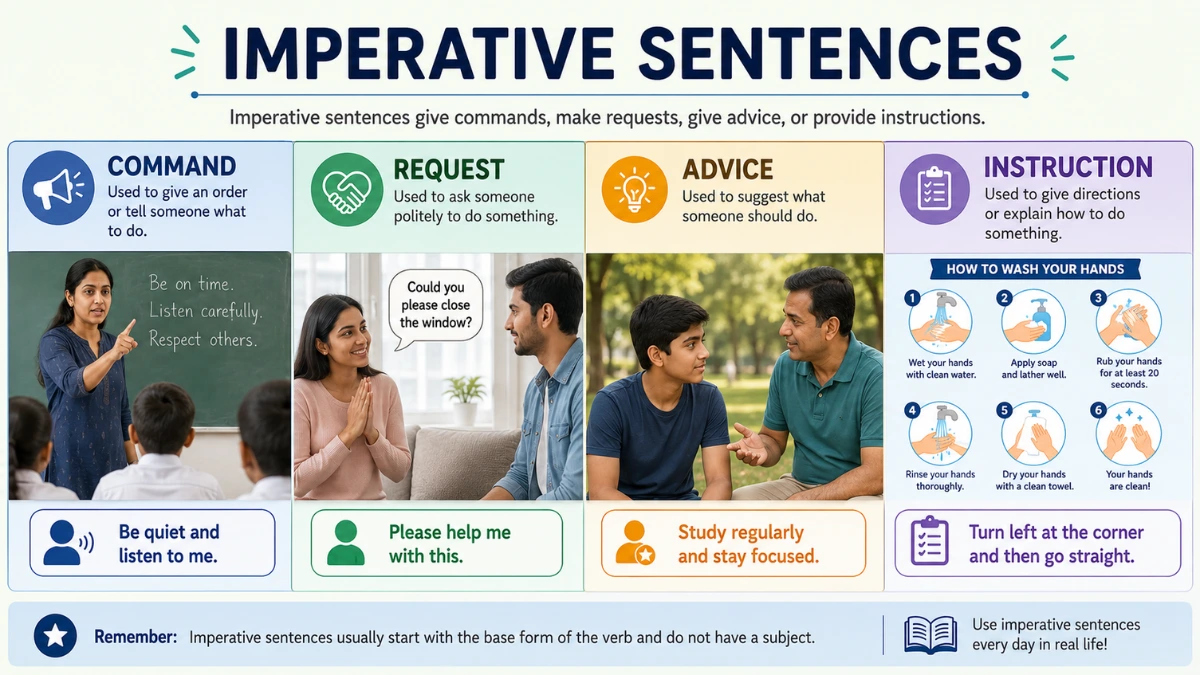
An imperative sentence is a sentence that gives a command, request, advice, or instruction.
Simple idea: It tells someone to do or not do something.
Examples:
- Close the door.
- Please help me.
- Do not waste time.
These sentences are short, direct, and clear.
Why This Sentence Type is Important
Imperative sentences are very important because they are used in real life all the time.
They help to:
- Give clear instructions
- Communicate quickly
- Avoid confusion
- Make writing more direct
Without this sentence type, it would be difficult to guide someone or explain steps clearly.
Understanding the Hidden Subject
One special thing about imperative sentences is that the subject is usually not written.
The subject is “you”, but it is hidden.
Example:
- Open the window.
- → (You open the window)
- Write your answer.
- → (You write your answer)
This is why these sentences start directly with a verb.
Forms of Imperative Sentences
Imperative sentences can be written in different ways depending on tone and purpose.
1. Direct Form (Simple Command)
Used when giving clear instructions.
- Sit here.
- Finish your work.
2. Polite Form
Used to sound respectful and soft.
- Please close the door.
- Kindly send the details.
3. Negative Form
Used to stop an action.
- Do not run.
- Don’t make noise.
4. Suggestion Form (Using “Let’s”)
Used when including yourself in the action.
- Let’s start the meeting.
- Let’s go outside.
Sentence Structure Made Easy
Imperative sentences follow a simple pattern.
| Type | Structure | Example |
| Basic | Verb + Object | Open the book. |
| Polite | Please + Verb | Please sit down. |
| Negative | Do not + Verb | Do not shout. |
| Suggestion | Let’s + Verb | Let’s begin. |
Key Point: The verb always comes first.
Positive vs Negative Imperative
Understanding this difference helps in writing correctly.
Positive Imperative
Used to tell someone to do something.
- Drink water.
- Complete your task.
Negative Imperative
Used to stop someone.
- Do not argue.
- Don’t waste time.
| Type | Example |
| Positive | Follow the instructions. |
| Negative | Do not ignore the rules. |
Real-Life Usage of Imperative Sentences
This sentence type is used in many everyday situations.
Daily Conversations
- Call me later.
- Bring your bag.
Instructions
- Mix the ingredients.
- Turn off the light.
Public Messages
- Keep silence.
- Follow the rules.
Professional Communication
- Send the report.
- Check the email.
These examples show how useful and practical imperative sentences are.
Common Confusions Explained Clearly
Confusion 1: Are imperative sentences always rude?
No. They can be polite with words like “please”.
- Close the door. (Direct)
- Please close the door. (Polite)
Confusion 2: Why is “you” not written?
- Because it is already understood.
Confusion 3: Is “Let’s” an imperative?
- Yes, it is used for suggestions.
Common Mistakes and Corrections
| Wrong Sentence | Correct Sentence | Explanation |
| You close the door. | Close the door. | Subject is not needed |
| Don’t to speak. | Do not speak. | “To” is incorrect here |
| Please you sit down. | Please sit down. | No subject required |
| Not open the file. | Do not open the file. | Use correct negative form |
| Always you be honest. | Always be honest. | Wrong word order |
Imperative vs Other Sentences
Understanding differences helps avoid confusion.
| Sentence Type | Purpose | Example |
| Declarative | Gives information | She is tired. |
| Interrogative | Asks a question | Are you ready? |
| Exclamatory | Shows emotion | What a surprise! |
| Imperative | Gives instruction | Open the door. |
Step-by-Step Way to Identify Imperative Sentences
This method makes learning very easy:
Step 1: Look at the first word
- If the sentence starts with a verb, it may be imperative.
Step 2: Check the purpose
- Is it giving instruction, advice, or request?
Step 3: Find hidden “you”
- Try adding “you” at the beginning.
Step 4: Check positive or negative form
- Look for “do not” or “don’t”.
Practical Application in Writing and Speaking
Imperative sentences are very useful in real situations.
In Writing Instructions
Example: “Open the document. Read the instructions carefully. Write your answer clearly. Do not skip any step.”
In Daily Communication
- Send the message.
- Please reply soon.
In Paragraph Writing
Example:
- “Wake up early. Exercise daily. Eat healthy food. Avoid junk food. Stay active and positive.”
- This shows how these sentences make communication clear and effective.
Helpful Learning Tips
- Practice making simple instructions daily
- Use polite words to improve tone
- Try writing both positive and negative sentences
- Observe real conversations
- Read instructions from books or manuals
Summary
| Key Point | Explanation |
| Meaning | Sentence used to give order, request, or advice |
| Structure | Starts with a verb |
| Subject | Hidden “you” |
| Forms | Positive, Negative, Polite, Suggestion |
| Use | Daily communication and instructions |
Conclusion
Imperative sentences are simple, practical, and very important in English. They help in giving instructions, making requests, and sharing advice clearly. Once the concept is understood, using them becomes natural in both speaking and writing.
The key is regular practice and real-life usage. Pay attention to how people speak, read instructions carefully, and try using these sentences daily. Over time, this small concept can make a big improvement in communication skills.
Frequently Asked Questions (FAQs)
What is imperative sentence in simple words?
It is a sentence that tells someone to do something.
Can it be polite?
Yes, by using words like “please” or “kindly”.
Why is the subject not written?
Because “you” is already understood.
How to make a negative imperative sentence?
Use “do not” or “don’t” before the verb.
Where are imperative sentences used?
They are used in daily conversation, instructions, and communication.