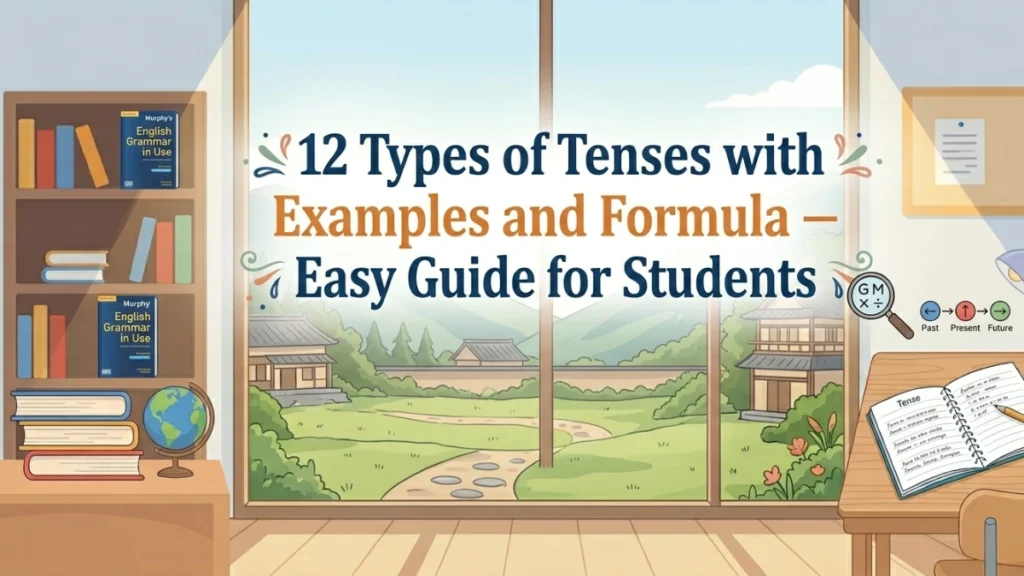
Tenses are one of the most important parts of English grammar. They help us understand when an action happens—in the past, present, or future. Many students in Pakistan and other countries find tenses confusing, but with the right explanation, they become much easier to understand.
In this article, you will learn the 12 types of tenses with examples and formula in a very simple and clear way. Each tense will be explained step-by-step with formulas, tables, and examples from daily life. This guide is useful for students from Grade 5 to Grade 12 who want to improve their English speaking, writing, and exam performance.
By the end of this lesson, you will understand how to use all tenses correctly and confidently.
Definition of Tenses
Tense shows the time of an action in a sentence. It tells us whether the action happens in the past, present, or future.
Examples:
- I play cricket. (Present time)
I played cricket yesterday. (Past time)
I will play cricket tomorrow. (Future time)
These sentences show how the verb changes according to time.
Types or Kinds of Tenses
There are 12 types of tenses in English grammar. They are divided into three main groups:
| Main Tense | Sub Types |
| Present Tense | Present Simple, Present Continuous, Present Perfect, Present Perfect Continuous |
| Past Tense | Past Simple, Past Continuous, Past Perfect, Past Perfect Continuous |
| Future Tense | Future Simple, Future Continuous, Future Perfect, Future Perfect Continuous |
Structure or Formula of 12 Types of Tenses
This table shows the 12 types of tenses with examples and formula in an easy way.
| Tense Name | Formula | Example Sentence |
| Present Simple | Subject + V1 + s/es | She plays football. |
| Present Continuous | Subject + is/am/are + V1+ing | She is playing football. |
| Present Perfect | Subject + has/have + V3 | She has played football. |
| Present Perfect Continuous | Subject + has/have been + V1+ing | She has been playing football. |
| Past Simple | Subject + V2 | She played football. |
| Past Continuous | Subject + was/were + V1+ing | She was playing football. |
| Past Perfect | Subject + had + V3 | She had played football. |
| Past Perfect | Continuous Subject + had been + V1+ing | She had been playing football. |
| Future Simple | Subject + will + V1 | She will play football. |
| Future Continuous | Subject + will be + V1+ing | She will be playing football. |
| Future Perfect | Subject + will have + V3 | She will have played football. |
| Future Perfect Continuous | Subject + will have been + V1+ing | She will have been playing football. |
Rules of Tenses
Understanding the rules helps students use tenses correctly.
Present Simple Tense
Used for daily habits and general truths.
Examples:
- I wake up early.
- The sun rises in the east.
Present Continuous Tense
Used for actions happening now.
Examples:
- I am studying English.
- They are playing cricket.
Present Perfect Tense
Used for completed actions.
Examples:
- She has finished her homework.
- We have eaten dinner.
Past Simple Tense
Used for actions completed in the past.
Examples:
- I visited Lahore last year.
- He bought a book.
Future Simple Tense
Used for future actions.
Examples:
- I will call you tomorrow.
- They will travel next week.
Examples of 12 Types of Tenses
Here are clear daily-life examples:
- I go to school daily.
- She is cooking food now.
- They have cleaned the room.
- He has been studying for two hours.
- We played cricket yesterday.
- She was reading a book.
- I had finished my work.
- They had been waiting for an hour.
- He will visit Karachi.
- We will be watching TV tonight.
Common Mistakes in Tenses
Many students make similar mistakes. Learn from these examples.
| Wrong Sentence | Correct Sentence | Explanation |
| She go to school | She goes to school | Add s with singular subject. |
| I am go to market | I am going to market | Use V1+ing. |
| He have finished work | He has finished work | Use has with singular. |
| They was playing | They were playing | Use were with plural. |
| I will goes tomorrow | I will go tomorrow | Use base form after will. |
Tips to Remember
Follow these tips to understand the 12 types of tenses with examples and formula easily:
- Learn verb forms (V1, V2, V3).
- Practice making simple sentences daily.
- Read English newspapers or textbooks.
- Speak English sentences using different tenses.
- Revise formulas regularly.
Real-Life Usage Sentences
These sentences show how tenses are used in daily life:
- I am doing my homework now.
- My father goes to office daily.
- We will attend the wedding tomorrow.
- She has prepared lunch.
- They were watching TV last night.
How to Use the 12 Types of Tenses Correctly (Step-by-Step Guide)
This section explains how students can use tenses in a practical way without leaving empty blanks. It is useful for both beginners and intermediate students who want to improve their grammar step by step.
Step-by-Step Method to Learn Tenses
Follow these simple steps daily to understand the 12 types of tenses with examples and formula easily and confidently.
Start with Present Simple Tense first
- This is the easiest tense and is used to talk about daily routines and habits. Learning this tense first helps build a strong base.
- Example: I wake up early every day.
Learn verb forms (V1, V2, V3) regularly
- In every tense, the verb form changes. If your verb forms are strong, learning tenses becomes much easier and faster.
Practice one tense at a time
- Instead of trying to memorize all tenses together, focus on learning one tense each day. This method helps you understand clearly without confusion.
Make 3–5 daily-life sentences using each tense
- Writing sentences about your daily routine helps you remember tense rules quickly and naturally.
Read short English paragraphs daily
- Reading helps you understand how different tenses are used in real sentences. It also improves your vocabulary and sentence structure.
Speak simple English sentences aloud
- Speaking sentences loudly improves confidence and helps you remember correct tense usage for a long time.
Key Points Summary
- Tense shows time of action.
- There are 12 types of tenses in English.
- Each tense has its own formula.
- Learn verb forms carefully.
- Practice sentences every day for improvement.
Read More: What Is Narration in English Grammar? Easy Rules, Types, Examples & Student Guide
Conclusion
Learning the 12 types of tenses with examples and formula is very important for mastering English grammar. Tenses help students express ideas clearly and correctly in speaking and writing. Although learning all 12 tenses may seem difficult at first, regular practice makes it easy.
Start with simple tenses and slowly move to advanced ones. Use daily-life examples and practice exercises to improve your understanding. With time and practice, you will be able to use all tenses confidently.
Frequently Asked Questions
What are the 12 types of tenses in English?
The 12 types of tenses are divided into three main groups: present, past, and future. Each group has four forms: simple, continuous, perfect, and perfect continuous. These tenses help us describe actions happening at different times.
Why is it important to learn all 12 types of tenses?
Learning all 12 tenses helps students speak and write correct English. It also improves sentence structure, makes communication clear, and helps students perform better in exams and daily conversations.
Which tense should beginners learn first?
Beginners should start with the Present Simple Tense because it is easy to understand and used in daily routines and habits. After learning it well, students can move to present continuous and past simple tenses.
How can students remember tense formulas easily?
Students can remember tense formulas by practicing small sentences every day, revising verb forms (V1, V2, V3), and reading simple English passages. Writing daily examples also helps to remember formulas for a long time.
How do tenses help in real-life communication?
Tenses help us explain when an action happens, such as yesterday, today, or tomorrow. They make our speaking and writing clear so others can understand our message correctly.