Many students feel confused when they start learning tenses, especially present tenses. One of the most common questions students ask is how many types of present tenses are there and how to use them correctly in daily English.
Present tenses are very important because we use them every day while speaking, writing essays, answering exam questions, and talking about routines. If you understand present tenses well, your English writing and speaking become clearer and more confident.
In this easy guide, you will learn how many types of present tenses are there, their meanings, structures, rules, and real-life examples. The explanations are simple so students from Grade 5 to Grade 12 can understand them easily.
Understanding Present Tense in Simple Words
Present tense tells us about actions that happen now, regularly, or generally.
For example:
- I play cricket.
- She is reading a book.
- We have finished our homework.
All these sentences show actions related to the present time.
How Many Types of Present Tenses Are There?
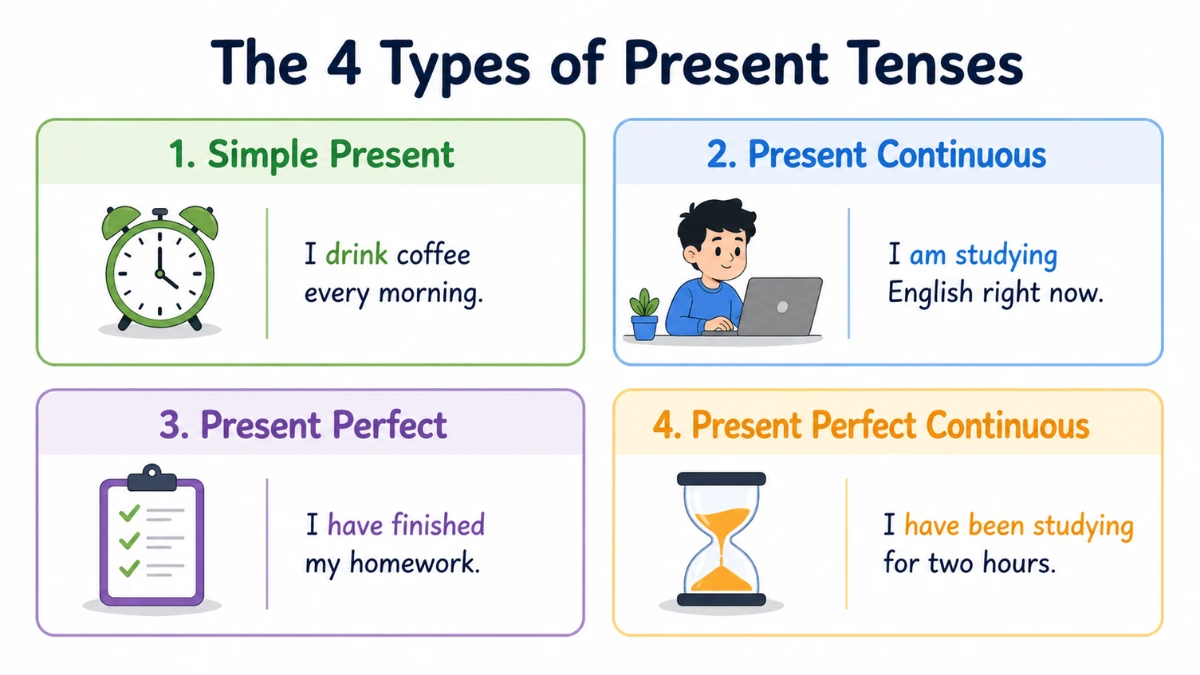
There are four main types of present tenses in English grammar.
These four types help us talk about different kinds of present actions.
The Four Types of Present Tenses
| No. | Type of Present Tense | Main Use | Simple Example |
| 1 | Simple Present Tense | Daily routines and facts | I play football. |
| 2 | Present Continuous Tense | Action happening now | She is reading. |
| 3 | Present Perfect Tense | Completed action with result now | They have finished work. |
| 4 | Present Perfect Continuous Tense | Action continuing from past till now | He has been studying. |
So, whenever someone asks how many types of present tenses are there, the correct answer is four types.
1. Simple Present Tense
Meaning of Simple Present Tense
Simple present tense is used to describe:
- Daily habits
- General facts
- Timetables
- Permanent situations
This is the most commonly used present tense in everyday English.
Structure of Simple Present Tense
| Sentence Type | Structure | Example |
| Affirmative | Subject + Verb (1st form) | I play cricket. |
| Negative | Subject + do/does not + Verb | She does not eat rice. |
| Interrogative | Do/Does + Subject + Verb? | Do you read books? |
Daily-Life Examples
- I wake up at 6 a.m.
- She goes to school daily.
- The sun rises in the east.
- We study English every day.
2. Present Continuous Tense
Meaning of Present Continuous Tense
- Present continuous tense shows actions that are happening right now or at this moment.
- We often use this tense when describing current activities.
Structure of Present Continuous Tense
| Sentence Type | Structure | Example |
| Affirmative | Subject + is/am/are + Verb + ing | He is playing. |
| Negative | Subject + is/am/are not + Verb + ing | They are not running. |
| Interrogative | Is/Am/Are + Subject + Verb + ing? | Are you writing? |
Daily-Life Examples
- I am doing my homework.
- She is watching TV.
- They are playing cricket outside.
- We are learning grammar.
3. Present Perfect Tense
Meaning of Present Perfect Tense
- Present perfect tense is used for actions that have finished recently but their result is important now.
- This tense connects the past action with the present result.
Structure of Present Perfect Tense
| Sentence Type | Structure | Example |
| Affirmative | Subject + has/have + Verb (3rd form) | She has completed work. |
| Negative | Subject + has/have not + Verb (3rd form) | I have not eaten food. |
| Interrogative | Has/Have + Subject + Verb (3rd form)? | Have you finished homework? |
Daily-Life Examples
- I have finished my homework.
- She has cleaned the room.
- They have arrived at school.
- We have learned new words.
4. Present Perfect Continuous Tense
Meaning of Present Perfect Continuous
- This tense is used for actions that started in the past and are still continuing in the present.
- It focuses on duration (time) of the action.
Structure of Present Perfect Continuous Tense
| Sentence Type | Example | Example |
| Affirmative | Subject + has/have been + Verb + ing | He has been studying. |
| Negative | Subject + has/have not been + Verb + ing | She has not been sleeping. |
| Interrogative | Has/Have + Subject + been + Verb + ing? | Have you been playing? |
Daily-Life Examples
- I have been reading for two hours.
- She has been cooking since morning.
- They have been playing cricket for an hour.
- We have been waiting for the teacher.
Quick Comparison of All Present Tenses
This table helps students understand differences clearly.
| Tense | Time Focus | Example Sentence |
| Simple Present | Routine or fact | I go to school. |
| Present Continuous | Happening now | I am going to school. |
| Present Perfect | Recently finished | I have gone to school. |
| Present Perfect Continuous | Continuing action | I have been going to school. |
Common Mistakes Students Make in Present Tenses
Many students mix verb forms or helping verbs. The following table shows common mistakes.
| Wrong Sentence | Correct Sentence | Explanation |
| She go to school. | She goes to school. | Add s with singular subject. |
| I am play cricket. | I am playing cricket. | Use ing with continuous tense. |
| He have finished work. | He has finished work. | Use has with he/she/it. |
| They has completed homework. | They have completed homework. | Use have with plural subject. |
| I have been read for two hours. | I have been reading for two hours. | Use ing form after been. |
Real-Life Usage of Present Tenses
Present tenses are used in daily conversations, school work, and exams.
Here are some natural daily-life examples.
| Situation | Sentence Example | Tense Used |
| Daily routine | I wake up early. | Simple Present |
| Current activity | She is cooking food. | Present Continuous |
| Recently completed work | I have cleaned my desk. | Present Perfect |
| Ongoing activity | He has been studying since morning. | Present Perfect Continuous |
These examples show how important it is to understand how many types of present tenses are there and when to use each one.
Practical Application or Real Student Usage
Students use present tenses in school writing every day. Knowing the correct tense helps improve marks in exams.
In Essay Writing
Example:
- I wake up early and go to school.
- My mother is preparing breakfast.
- I have completed my homework.
These sentences use different present tenses in one paragraph.
In Classroom Activities
Situation:
- Teacher asks: What are you doing now?
- Student replies: I am writing my notes.
In Exam Answers
Question: Write about your daily routine.
Answer:
- I get up early.
- I brush my teeth.
- I go to school at 7 a.m.
Simple present tense is mostly used in routine writing.
Why Learning Present Tenses Is Important
Understanding present tenses improves:
- Speaking confidence
- Writing accuracy
- Grammar understanding
- Exam performance
When students clearly know how many types of present tenses are there, they can choose the correct tense easily.
Summary of Important Points
| Topic | Key Idea |
| Number of Types | There are four types of present tenses. |
| Most Common Tense | Simple Present is used most often. |
| Continuous Actions | Present Continuous shows actions happening now. |
| Completed Actions | Present Perfect shows completed actions. |
| Duration Actions | Present Perfect Continuous shows ongoing actions. |
Conclusion
Now you clearly understand how many types of present tenses are there and how each type is used in daily English. There are four types of present tenses, and each one has its own purpose.
Learning present tenses may feel difficult at first, but with regular practice, it becomes easy. Try to use different present tenses while speaking and writing every day. The more you practice, the more confident your English will become.
Remember, strong grammar skills help students perform better in exams and communicate clearly in real life.
Frequently Asked Questions (FAQs)
How many types of present tenses are there in English?
There are four types of present tenses in English. These include Simple Present, Present Continuous, Present Perfect, and Present Perfect Continuous. Each tense is used for a different type of present action.
Which present tense is mostly used in daily routine writing?
Simple present tense is mostly used to describe daily routines and habits. For example, students often write sentences like “I wake up early” or “She goes to school every day.”
How can I easily remember all four present tenses?
You can remember them by understanding their main purpose. Simple Present is for routines, Present Continuous is for actions happening now, Present Perfect is for completed actions, and Present Perfect Continuous is for actions continuing over time.
Why do students make mistakes in present tenses?
Students usually make mistakes because they forget helping verbs like is, am, are, has, or have. They may also use the wrong verb form, especially in continuous and perfect tenses.
How can I improve my present tense usage for exams?
You can improve by practicing daily writing and reading simple English sentences. Writing short paragraphs about your daily routine is one of the best ways to become confident in present tenses.