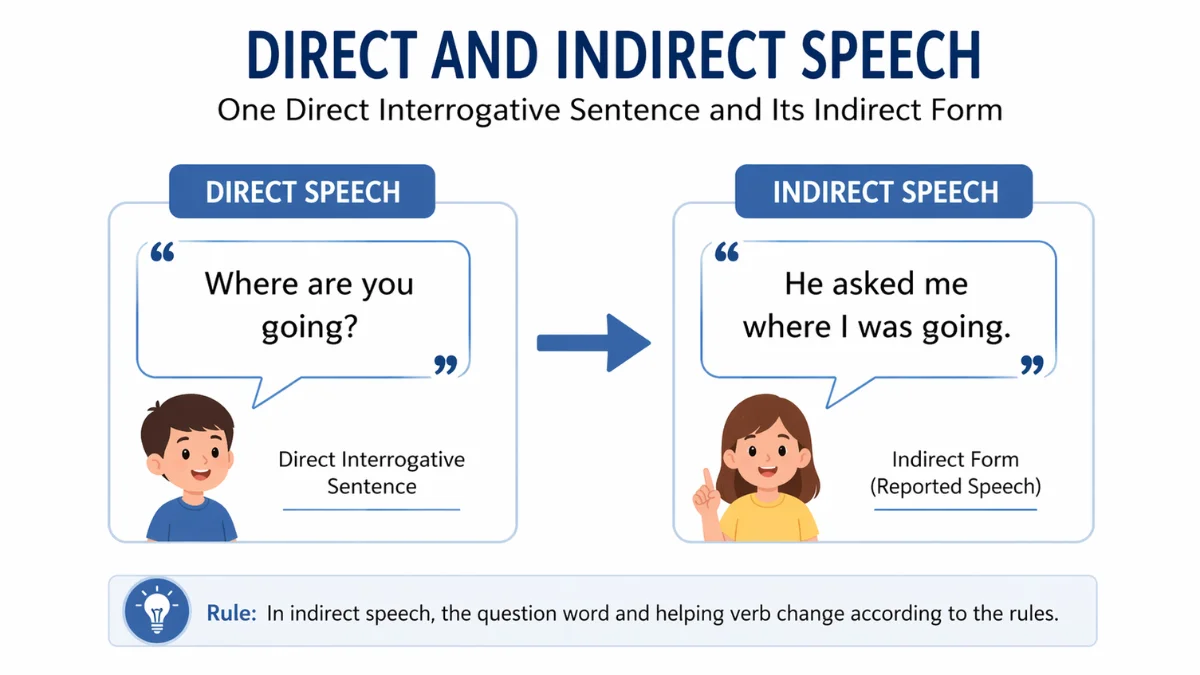
Interrogative sentences are questions, and they are very common in daily communication. Students often face difficulty when changing questions from direct speech to indirect speech. That is why learning direct and indirect speech interrogative sentences examples is very important for school exams and everyday English writing.
In Pakistan and many other countries where English is learned as a second language, narration questions are frequently asked in exams. If you understand the rules properly, you can easily change direct questions into indirect speech without confusion.
In this guide, you will learn simple rules, structures, and many examples of interrogative sentences. The explanations are written in easy English, just like a teacher explaining in class. By the end of this article, you will feel more confident while solving narration questions.
What Are Interrogative Sentences in Direct and Indirect Speech?
An interrogative sentence is a sentence that asks a question. It usually ends with a question mark (?) in direct speech.
When we change a question into indirect speech:
- The question mark (?) is removed.
- The sentence becomes a statement.
- Words like if or whether may be used.
- The verb tense often changes.
Simple Understanding Table
| Feature | Direct Speech | Indirect Speech |
| Sentence Type | Question | Statement |
| Punctuation | Uses (?) | No (?) |
| Reporting Verb | said to | asked, inquired |
| Punctuation | Not used | if, whether, or question word |
Types of Interrogative Sentences in Narration
Interrogative sentences are mainly of two types, and each type follows slightly different rules.
1. Yes/No Questions
These are questions that can be answered with Yes or No.
Examples Table
| Direct Speech | Indirect Speech |
| He said to me, “Are you ready?” | He asked me if I was ready. |
| She said, “Do you like tea?” | She asked whether I liked tea. |
| Father said, “Did you finish homework?” | Father asked if I had finished homework. |
2. Wh-Questions
These questions begin with who, what, when, where, why, how, etc.
Examples Table
| Direct Speech | Indirect Speech |
| He said, “Where do you live?” | He asked where I lived. |
| She said, “Why are you late?” | She asked why I was late. |
| Teacher said, “When will you come?” | Teacher asked when I would come. |
Important Rules for Changing Interrogative Sentences
Understanding the rules is the key to mastering direct and indirect speech interrogative sentences examples.
Rule Summary Table
| Rule Number | Rule | Example |
| Rule 1 | Change said to into asked | He said to me → He asked me |
| Rule 2 | Remove question mark (?) | “Are you ready?” → if I was ready |
| Rule 3 | Use if/whether for Yes/No questions | Do you play? → if I played |
| Rule 4 | Keep Wh-word in Wh-questions | Where are you? → where I was |
| Rule 5 | Change tense if required | are → were |
| Rule 6 | Change pronouns correctly | you → I / he / she |
Structure Formula for Interrogative Sentences
Understanding structure makes narration much easier.
Yes/No Question Structure
| Step | What to Do | Example |
| Step 1 | Write Reporting Subject | He |
| Step 2 | Change said to into asked | asked |
| Step 3 | Add Object | me |
| Step 4 | Use if or whether | if |
| Step 5 | Write Subject | I |
| Step 6 | Write Verb (change tense if needed) | was tired |
Example:
- Direct Speech: He said to me, “Are you tired?”
- Indirect Speech: He asked me if I was tired.
Structure for Wh-Questions
| Step | What to Do | Example |
| Step 1 | Write Reporting Subject | She |
| Step 2 | Use asked | asked |
| Step 3 | Add Object | me |
| Step 4 | Keep Wh-word | where |
| Step 5 | Write Subject | I |
| Step 6 | Write Verb (change tense if needed) | was going |
Example:
- Direct Speech: She said, “Where are you going?”
- Indirect Speech: She asked me where I was going.
Direct and Indirect Speech Interrogative Sentences Examples
Here are several carefully selected examples to help students understand clearly.
Yes/No Questions Examples
| Direct Speech | Indirect Speech |
| He said to me, “Do you play cricket?” | He asked me if I played cricket. |
| She said, “Are you happy?” | She asked whether I was happy. |
| Teacher said, “Did you study today?” | Teacher asked if I had studied that day. |
| Mother said, “Will you help me?” | Mother asked if I would help her. |
| Ali said, “Can you swim?” | Ali asked if I could swim. |
Wh-Questions Examples
| Direct Speech | Indirect Speech |
| He said, “What are you doing?” | He asked what I was doing. |
| She said, “Where did you go?” | She asked where I had gone. |
| Teacher said, “Why are you laughing?” | Teacher asked why I was laughing. |
| Father said, “Who broke the glass?” | Father asked who had broken the glass. |
| She said, “How will you solve this?” | She asked how I would solve that. |
Special Notes Students Must Remember
Some small points help avoid mistakes.
- Use asked instead of said.
- Remove quotation marks.
- Change the sentence into statement form.
- Do not use if/whether with Wh-questions.
- Change pronouns carefully.
These small details improve accuracy in exams.
Common Mistakes Students Make
Below are mistakes that many students in schools make while writing narration.
| Wrong Sentence | Correct Sentence | Explanation |
| He asked me that if I was ready. | He asked me if I was ready. | Do not use that before if |
| She asked where did I live. | She asked where I lived. | Remove helping verb before subject |
| He asked me whether did I finish work. | He asked me whether I finished work. | Use statement order |
| Teacher asked that why I was late. | Teacher asked why I was late. | Do not use that in Wh-question |
| He asked me if was I tired. | He asked me if I was tired. | Correct subject-verb order |
Real-Life Usage of Interrogative Narration
Interrogative sentences are used daily in conversations. Students should understand how they appear in real situations.
Daily Conversation Examples
| Situation | Direct Speech | Indirect Speech |
| At School | Teacher said, “Did you bring your book?” | Teacher asked if I had brought my book. |
| At Home | Mother said, “Where are your shoes?” | Mother asked where my shoes were. |
| In Market | Shopkeeper said, “What do you need?” | Shopkeeper asked what I needed. |
| Among Friends | Friend said, “Are you coming today?” | Friend asked if I was coming that day. |
These examples show how narration is used in daily communication.
Practical Application in School Writing
Understanding direct and indirect speech interrogative sentences examples helps students in real exam situations.
Mini School Situations
Situation 1: Classroom Conversation
- Teacher said, “Why did you miss school?”
- Student writes: Teacher asked why I had missed school.
Situation 2: Writing a Story
- Direct: Mother said, “Where are you going?”
- Indirect: Mother asked where I was going.
Situation 3: English Exam Question
- Direct: He said to me, “Will you help me?”
- Indirect: He asked me if I would help him.
These examples show how narration questions appear in school tests.
Pronoun and Tense Changes in Interrogative Sentences
Pronouns and tenses change depending on context.
Pronoun Change Table
| Direct Pronoun | Indirect Pronoun |
| I | he/she |
| you | I/he/she |
| we | they |
| my | his/her |
| our | their |
Tense Change Table
| Direct Tense | Indirect Tense |
| Present Simple | Past Simple |
| Present Continuous | Past Continuous |
| Past Simple | Past Perfect |
| Will | Would |
| Can | Could |
Understanding these changes makes narration easier.
How to Identify Whether to Use If or Wh-Word
Students often get confused about this step.
Decision Table
| Question Type | Word Used | Example |
| Yes/No Question | if / whether | Are you ready? → if I was ready |
| Wh-Question | Keep Wh-word | Where are you? → where I was |
This simple rule solves many problems.
Quick Teacher Tips for Students
Use these short tips to improve quickly:
- Always read the sentence carefully.
- Identify question type first.
- Change word order into statement form.
- Practice daily examples.
- Revise tense rules regularly.
Summary of Important Points
Here is a quick revision of the topic.
| Topic | Key Idea |
| Interrogative Sentence | A sentence that asks a question |
| Reporting Verb | Use asked |
| Yes/No Questions | Use if/whether |
| Wh-Questions | Keep Wh-word |
| Question Mark | Remove in indirect speech |
| Word Order | Change to statement form |
Read More: What Part of Speech Is Themselves? 5 Easy Rules and Examples for Students
Conclusion
Learning direct and indirect speech interrogative sentences examples is an important part of English grammar for students. Once you understand the difference between Yes/No questions and Wh-questions, narration becomes much easier.
Remember the basic rules: change said to into asked, remove the question mark, and follow correct word order. With regular practice, you will feel confident while solving narration questions in exams.
Keep practicing examples and reviewing rules. The more you practice, the stronger your English grammar skills will become.
Frequently Asked Questions (FAQs)
What is an interrogative sentence in narration?
An interrogative sentence is a question that is changed into statement form when converted into indirect speech.
When do we use “if” or “whether”?
We use if or whether in Yes/No questions when converting them into indirect speech.
Do we keep Wh-words in indirect speech?
Yes, Wh-words such as where, why, when remain in indirect speech.
Why do we remove the question mark in indirect speech?
Because indirect speech becomes a statement, not a direct question.
How can students improve narration skills?
Students can improve by practicing daily examples and learning tense and pronoun changes properly.