Many students feel confused when they see the word “themselves” in a sentence. They often ask, what part of speech is themselves, and how it is used correctly in English grammar. Understanding this word is important because it appears in school essays, comprehension passages, and exam questions.
In English grammar, each word belongs to a part of speech, such as noun, verb, adjective, or pronoun. Knowing the role of “themselves” helps students write correct sentences and avoid common mistakes. This topic is especially useful for students in Pakistan and other countries where English is learned as a second language.
In this detailed guide, you will learn the meaning of “themselves,” its part of speech, its rules, examples, common mistakes, and real-life uses in simple and easy language.
Understanding the Word “Themselves” in Grammar
The word “themselves” belongs to the pronoun family. More specifically, it is called a reflexive pronoun.
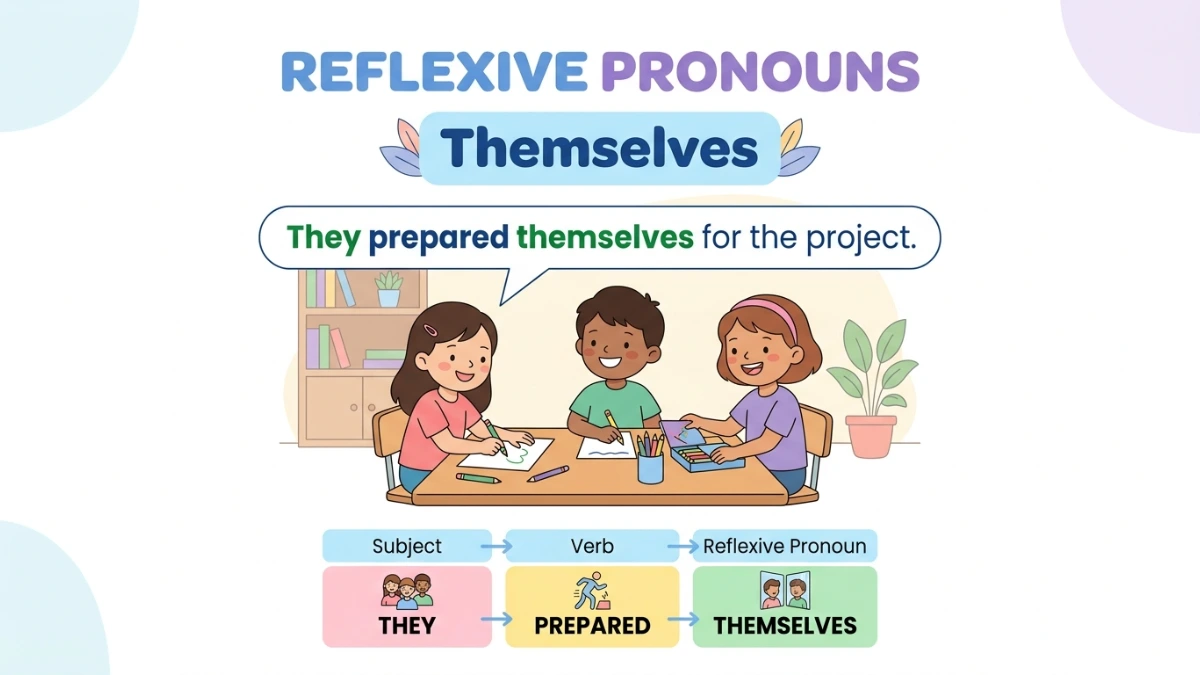
A reflexive pronoun is used when the subject and the object of a sentence refer to the same person or group. In simple words, the action of the verb goes back to the subject.
For example:
They cleaned the classroom themselves.
In this sentence:
- They = Subject
- cleaned = Verb
- themselves = Reflexive Pronoun
The action of cleaning is done by they, and it also refers back to they.
What Part of Speech Is Themselves? (Clear Definition)
Themselves is a pronoun, specifically a reflexive pronoun.
It refers to more than one person (plural) and is used when those people perform an action on their own.
Table: Part of Speech of “Themselves”
| Word | Part of Speech | Type | Usage |
| Themselves | Pronoun | Reflexive Pronoun | Refers back to plural subject |
| Themselves | Pronoun | Emphatic Pronoun | Adds emphasis to subject |
So, the answer to the question what part of speech is themselves is:
- “Themselves” is a reflexive pronoun and sometimes an emphatic pronoun.
Reflexive Pronouns and Where “Themselves” Fits
Reflexive pronouns are formed by adding -self or -selves to personal pronouns.
Table: List of Reflexive Pronouns
| Personal Pronoun | Reflexive Pronoun |
| I | Myself |
| You | Yourself |
| He | Himself |
| She | Herself |
| It | Itself |
| We | Ourselves |
| You (plural) | Yourselves |
| They | Themselves |
From this table, we can see that “themselves” is used with the pronoun “they.”
When “Themselves” Is Used as a Reflexive Pronoun
“Themselves” is used as a reflexive pronoun when the subject and object are the same group.
Table: Reflexive Pronoun Usage Examples
| Sentence | Subject Reflexive | Pronoun | Meaning |
| The students prepared themselves for exams. | Students | Themselves | Students prepared their own selves |
| They blamed themselves for the mistake. | They | Themselves | They blamed their own selves |
| The players trained themselves daily. | Players | Themselves | Players trained on their own |
These examples clearly show how “themselves” refers back to the same group.
When “Themselves” Is Used as an Emphatic Pronoun
Sometimes, “themselves” is used to add emphasis to the subject. In this case, it is called an emphatic pronoun.
It does not act as an object but gives extra stress to show that someone did something personally.
Table: Emphatic Pronoun Examples
| Sentence | Meaning |
| The teachers themselves checked the papers. | Teachers personally checked papers |
| The students themselves solved the problem. | Students solved it without help |
| The players themselves carried the equipment. | Players did it personally |
In such cases, “themselves” is not required for grammar, but it adds importance and emphasis.
Sentence Structure with “Themselves”
Understanding sentence structure helps students use reflexive pronouns correctly.
Table: Sentence Patterns
| Structure Type | Sentence Pattern | Example |
| Reflexive Use | Subject + Verb + Themselves | They introduced themselves. |
| Emphatic Use | Subject + Themselves + Verb | The students themselves decorated the hall. |
| End Emphasis | Subject + Verb + Object + Themselves | They completed the project themselves. |
These structures are commonly used in school writing and exams.
Rules for Using “Themselves” Correctly
There are some simple rules students must remember when using “themselves.”
Table: Important Rules
| Rule | Explanation | Example |
| Use with plural subjects | Used only for more than one person | They enjoyed themselves. |
| Must refer to subject | Subject and object must be same | Students helped themselves. |
| Do not use with singular nouns | Not correct with single person | Incorrect: Ali hurt themselves |
| Used for emphasis | Can show strong emphasis | The boys themselves repaired it. |
Following these rules helps avoid common grammar errors.
Common Mistakes Students Make with “Themselves”
Many learners make mistakes when using reflexive pronouns. Here are realistic examples students often write.
Table: Wrong vs Correct Sentences
| Wrong Sentence | Correct Sentence | Explanation |
| They enjoyed them. | They enjoyed themselves. | Reflexive pronoun needed |
| The girl hurt themselves. | The girl hurt herself. | Singular subject needs singular pronoun |
| Students blamed theirselves. | Students blamed themselves. | Correct form is “themselves” |
| They introduced them to teacher. | They introduced themselves to teacher. | Same subject needs reflexive form |
| The boys washed them. | The boys washed themselves. | Action refers to subject |
Learning from mistakes helps students improve faster.
Real-Life Usage of “Themselves” in Daily Communication
Students often use “themselves” in daily conversations and writing.
Here are natural examples used in everyday life:
- The children dressed themselves before school.
- The players prepared themselves for the match.
- The students taught themselves using online videos.
- The workers protected themselves from rain.
- The guests served themselves food.
These examples show that reflexive pronouns are useful in daily communication.
Difference Between Reflexive and Emphatic Use
Many students confuse reflexive and emphatic pronouns. Understanding the difference makes writing clearer.
Table: Reflexive vs Emphatic Use
| Feature | Reflexive Pronoun | Emphatic Pronoun |
| Purpose | Shows action returns to subject | Adds emphasis |
| Necessity | Required for meaning | Optional |
| Position | Usually after verb | Near subject |
| Example | They blamed themselves. | They themselves finished work. |
This comparison helps students understand both uses easily.
Practical Application in Student Writing
Students often use reflexive pronouns in essays, letters, and exam answers.
Here are practical situations where “themselves” is useful.
School Essay Example
The students prepared themselves for the science exhibition and presented their projects confidently.
Classroom Situation
The children helped themselves to books from the library shelf.
Examination Writing
The players trained themselves hard before the competition.
Group Activity Writing
- The team members introduced themselves to the new teacher.
- These examples show how grammar rules apply in real student writing.
How Teachers Explain “Themselves” in Simple Words
Teachers often explain reflexive pronouns using easy methods.
They say:
“If the subject does the action and also receives the action, use a reflexive pronoun like ‘themselves.’”
For example:
- They hurt themselves while playing.
- This simple explanation helps students remember the rule quickly.
- Teachers also encourage students to read sentences aloud. When students hear the sentence, they can easily understand if “themselves” fits correctly.
Summary of Important Points
Here is a quick summary of what you learned.
Table: Key Points Summary
| Topic | Important Idea |
| Part of Speech | Themselves is a pronoun |
| Type | Reflexive and emphatic pronoun |
| Number | Used with plural subjects |
| Main Function | Refers back to subject |
| Extra Function | Adds emphasis to subject |
Read More: How Many Types of Essays Are There in English? 4 Easy and Complete Guide for Students
Conclusion
Understanding what part of speech is themselves is an important step in learning English grammar correctly. As you have learned, “themselves” is a reflexive pronoun used with plural subjects when the action refers back to the same group. It can also be used as an emphatic pronoun to add emphasis.
By practicing examples, reading sentences, and applying these rules in school writing, students can improve their grammar skills confidently. The more you use reflexive pronouns in real-life sentences, the easier they become.
Keep practicing, and soon you will be able to use “themselves” correctly in essays, exams, and daily English writing.
Frequently Asked Questions (FAQs)
What part of speech is themselves in English grammar?
“Themselves” is a pronoun, specifically a reflexive pronoun used with plural subjects.
Can “themselves” be used for one person?
No. “Themselves” is used for plural subjects. For one person, use himself or herself.
Is “themselves” always necessary in a sentence?
No. It is necessary only in reflexive use. In emphatic use, it is optional.
What is the difference between “them” and “themselves”?
“Them” is an object pronoun, while “themselves” is a reflexive pronoun used when the subject and object are the same.
Can “themselves” come at the end of a sentence?
Yes. It often appears at the end, especially in emphatic sentences. Example: They completed the project themselves.