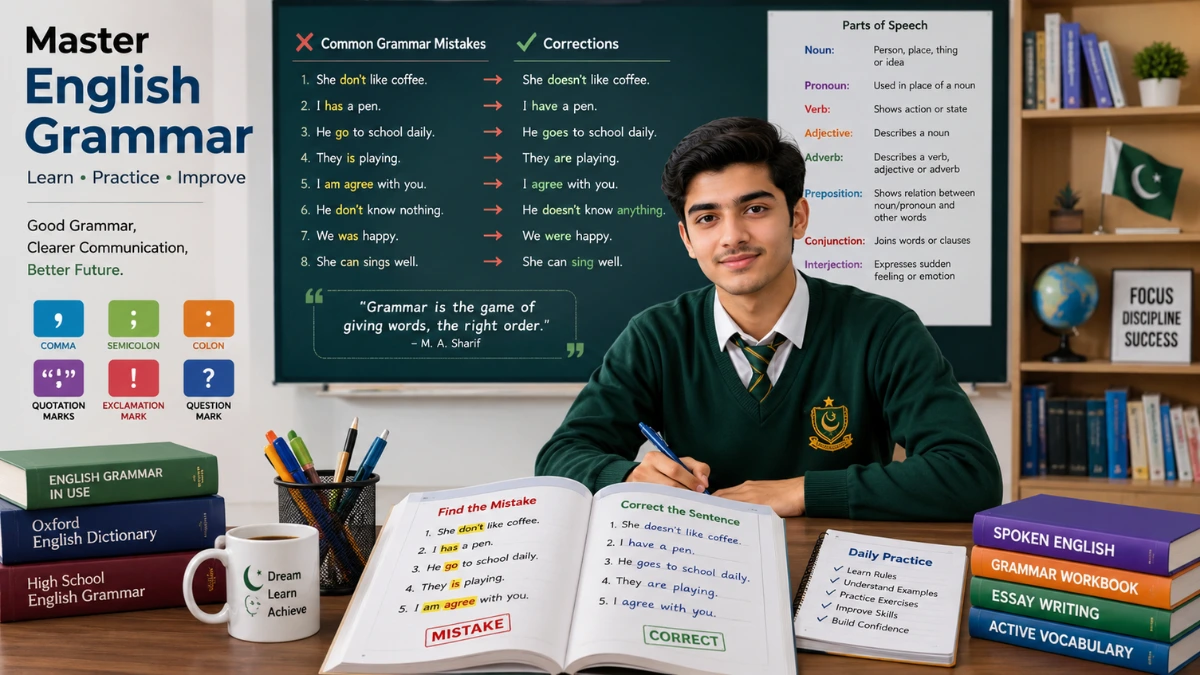
English grammar can feel difficult for many students, especially when English is not their first language. In Pakistan and many other countries, students often learn English in school but still make small grammar mistakes in essays, exams, conversations, and classroom writing.
The good news is that grammar mistakes can be improved step by step. Most students repeat the same errors because they do not fully understand the rules or because they translate directly from their local language into English.
This article explains the common mistakes in English grammar in a very simple and practical way. You will learn why these mistakes happen, how teachers correct them, and how students can naturally improve their English writing and speaking.
Why Grammar Mistakes Happen
Many students think grammar mistakes happen because they are weak in English. This is not always true. In reality, grammar mistakes happen for many different reasons.
One major reason is direct translation. Students often think in Urdu or another local language and then translate the sentence into English word by word. This creates incorrect sentence structure.
Another reason is memorization without understanding. Many students memorize grammar rules for exams but do not practice them in real writing. Because of this, they forget the correct usage during essays or conversations.
Lack of reading also causes grammar problems. Students who rarely read English books, articles, or newspapers do not see how correct sentences are naturally written.
Sometimes students are afraid of making mistakes, so they avoid writing long sentences. This slows down improvement.
Most Common English Grammar Mistakes
Below are some of the most common grammar mistakes students make in school and daily English writing.
1. Tense Mistakes
Tenses are one of the biggest grammar problems for learners. Students often mix past, present, and future forms in one sentence.
Wrong vs Correct Tense Usage
| Wrong Sentence | Correct Sentence | Explanation |
| He go to school daily. | He goes to school daily. | Present simple needs “goes” with he/she/it. |
| I am knowing the answer. | I know the answer. | “Know” is usually not used in continuous tense. |
| She did not went there. | She did not go there. | After “did,” use the base form of the verb. |
| We was playing cricket. | We were playing cricket. | “We” uses “were,” not “was.” |
| They has completed homework. | They have completed homework. | “They” uses “have.” |
Many students confuse tenses because they try to memorize too many rules at once. Teachers usually suggest learning tenses through daily examples instead of memorizing long formulas.
For example:
I eat breakfast at 8 AM.
I ate breakfast at 8 AM yesterday.
I will eat breakfast at 8 AM tomorrow.
When students compare these simple examples, they understand tense changes more naturally.
Subject-Verb Agreement Errors
Subject-verb agreement means the verb must match the subject correctly.
This is one of the most repeated mistakes in school essays and exam papers.
Common Subject-Verb Agreement Errors
| Subject | Wrong Usage | Correct Usage |
| He | He play football. | He plays football. |
| They | They is ready. | They are ready. |
| The students | The students was absent. | The students were absent. |
| My brother | My brother have a bike. | My brother has a bike. |
| I | I is happy. | I am happy. |
Students often make these mistakes during fast writing in exams. They focus on ideas and forget grammar structure.
A helpful trick is to identify the subject first before writing the verb.
For example:
- Ali plays cricket.
- The boys play cricket.
Even though both sentences talk about cricket, the verb changes because the subject changes.
Pronoun Mistakes
Pronouns replace nouns, but many learners use them incorrectly.
Common Pronoun Errors
| Wrong Sentence | Correct Sentence | Reason |
| Me and Ahmed went there. | Ahmed and I went there. | “I” is used as subject. |
| Everyone should bring their book. | Everyone should bring his or her book. | Singular pronoun agreement. |
| Him is my cousin. | He is my cousin. | “He” is subject pronoun. |
| This book belongs to she. | This book belongs to her. | “Her” is object pronoun. |
Students usually confuse pronouns because local languages may not follow the same sentence structure.
Teachers often correct these mistakes in essay writing and comprehension exercises.
Articles: A, An, and The
Articles are small words, but they create many grammar problems.
Article Mistakes Students Commonly Make
| Wrong Sentence | Correct Sentence | Explanation |
| He is a honest man. | He is an honest man. | “Honest” starts with vowel sound. |
| I saw elephant. | I saw an elephant. | Singular countable nouns need an article. |
| Sun rises in east. | The sun rises in the east. | Specific things use “the.” |
| She bought an university bag. | She bought a university bag. | “University” starts with “yu” sound. |
Students usually focus on spelling instead of sound. That is why they write “an university” instead of “a university.”
Capitalization and Punctuation Errors
Many students lose marks in exams because of punctuation mistakes.
These mistakes may look small, but they affect sentence clarity and professionalism.
Common Punctuation Mistakes
| Wrong Sentence | Correct Sentence |
| my name is Ali | My name is Ali. |
| I like apples oranges and bananas | I like apples, oranges, and bananas. |
| where are you going | Where are you going? |
| we visited lahore last year | We visited Lahore last year. |
| Its raining today | It’s raining today. |
Capital letters should be used for:
- Names
- Cities
- Countries
- Days
- Months
- Beginning of sentences
Students often forget punctuation while writing long answers quickly in exams.
Why Students Confuse Grammar Rules
This is an important issue many teachers notice in classrooms.
Students may study grammar for years but still repeat the same mistakes. This happens because grammar is often learned only for passing exams instead of real communication.
For example, many students know the rule of present perfect tense:
- “Has/have + past participle”
But during actual writing, they still write:
- “He have completed the work.”
Why does this happen?
Because students memorize formulas without practicing real sentences.
Another major problem is overthinking grammar. Some learners try to remember every rule while writing, which creates confusion and fear.
Good grammar develops slowly through reading, listening, speaking, and writing regularly.
Teachers usually encourage students to:
- Read English daily
- Write short paragraphs regularly
- Learn from corrections
- Notice patterns in sentences
Students who practice grammar naturally improve faster than students who only memorize rules.
Real-Life Student Writing Examples
Below are examples similar to mistakes teachers often find in school notebooks and exam papers.
Essay Writing Errors
| Student Sentence | Correct Sentence |
| Pakistan are a beautiful country. | Pakistan is a beautiful country. |
| I did not wrote the homework. | I did not write the homework. |
| My father give me good advice. | My father gives me good advice. |
| She was absent because she was ill yesterday night. | She was absent because she was ill last night. |
Daily Conversation Mistakes
| Wrong Conversation | Better Conversation |
| I am having two brothers. | I have two brothers. |
| He do not understand me. | He does not understand me. |
| Where you are going? | Where are you going? |
| I did not knew this. | I did not know this. |
These mistakes are common because students hear incorrect English around them in daily life.
Common Exam Errors Students Make
During exams, students often make grammar mistakes because of pressure and lack of revision.
Some very common exam mistakes include:
| Mistake Type | Why It Happens | Solution |
| Missing punctuation | Writing too fast | Leave 5 minutes for checking |
| Wrong tense | Mixing ideas | Stick to one timeline |
| Incorrect spelling | Weak reading habit | Read English daily |
| Long confusing sentences | Trying to sound advanced | Write clear short sentences |
| Subject-verb errors | Carelessness | Re-read every sentence |
Teachers usually recommend simple and clear writing instead of very difficult vocabulary.
A grammatically correct simple sentence is always better than a confusing complicated sentence.
How Teachers Correct Grammar
Many students become upset when teachers mark grammar mistakes in red ink. But correction is actually one of the best ways to improve English.
Teachers usually look for patterns. If a student repeatedly writes:
- “He go”
- “She go”
The teacher understands the student has a subject-verb agreement problem.
Good teachers do not only mark mistakes. They explain:
- What is wrong
- Why it is wrong
- How to fix it
Students improve faster when they rewrite corrected sentences themselves.
For example:
Wrong:
- She do her homework daily.
Correct:
- She does her homework daily.
Writing the corrected sentence again helps the brain remember the pattern.
Practical Tips to Improve Grammar Naturally
Improving grammar does not mean studying grammar books all day. Small daily habits make a huge difference.
Helpful Grammar Improvement Habits
| Habit | How It Helps |
| Reading English articles | Improves sentence structure |
| Watching English videos with subtitles | Builds grammar understanding naturally |
| Writing one paragraph daily | Develops writing confidence |
| Learning from corrections | Prevents repeated mistakes |
| Speaking simple English | Improves sentence formation |
Students should also keep a personal grammar notebook.
Whenever a teacher corrects a mistake, write:
- Wrong sentence
- Correct sentence
- Rule explanation
This becomes a powerful revision tool before exams.
Daily-Life Grammar Examples
Grammar is not only for exams. It is used everywhere.
In School
- Writing essays
- Answering comprehension questions
- Writing applications
- Completing grammar exercises
At Home
- Sending messages
- Writing emails
- Using social media
- Watching English content
In Future Careers
Good grammar helps in:
- Job applications
- Interviews
- Professional communication
- Office emails
Students who improve grammar early often become more confident communicators later in life.
Common Student Confusions
Many students ask similar grammar questions again and again.
“Why is English grammar so confusing?”
- English has many exceptions. Some rules change depending on context. That is why regular practice is important.
“Should I use difficult vocabulary?”
- No. Clear and correct English is better than difficult but incorrect English.
“Can grammar improve without coaching?”
- Yes. Reading, writing, and practicing daily can improve grammar greatly.
“Is speaking important for grammar?”
- Yes. Speaking helps students use grammar naturally instead of only memorizing rules.
Summary
Learning grammar takes time, but every student can improve with regular practice.
The most common mistakes in English grammar usually happen because students:
- Translate directly from local languages
- Memorize rules without practice
- Do not read enough English
- Ignore corrections
The best way to improve is to practice simple and correct English daily.
Small improvements every day create strong grammar over time.
Conclusion
Learning English grammar takes time, practice, and patience. Many students make grammar mistakes because they translate directly from their local language, memorize rules without understanding them, or do not practice enough writing and reading. These mistakes are normal, but they can improve slowly with regular learning and daily usage. Understanding the common mistakes in English grammar helps students write better essays, perform well in exams, and communicate more confidently in everyday life.
The best way to improve grammar is to practice simple and correct English regularly. Reading English articles, writing short paragraphs, learning from teacher corrections, and speaking English in daily conversations can make a big difference over time. Students should focus on clarity instead of difficult vocabulary and remember that every corrected mistake is a step toward stronger English skills and better confidence.
Frequently Asked Questions (FAQs)
What are the most common mistakes in English grammar?
The most common mistakes include tense errors, subject-verb agreement mistakes, punctuation errors, article misuse, and pronoun confusion.
How can students avoid grammar mistakes?
Students can avoid grammar mistakes by reading English regularly, practicing writing daily, and learning from corrections.
Why do students confuse English tenses?
Students often confuse tenses because they memorize rules instead of practicing real sentence usage.
Is grammar important for exams?
Yes. Good grammar improves marks in essays, comprehension, applications, and paragraph writing.
How long does it take to improve grammar?
Grammar improvement depends on practice. Daily reading and writing can show improvement within a few months.